
Antananarivo Your Madagascar Launch Pad
Start Planning


The Crazy Capital
Madagascar, completely untethered from the ordinary, is one of the wildest islands on this big green globe. So, try to imagine the capital city at its centre.
First came the island. The rainforests. The limestone cathedrals. The off-the-wall, weird creatures. And then came its people. Madagascar has always drawn in the curious. Seafarers. Traders. Adventurers. Dreamers. Antananarivo, or “Tana” if you prefer to travel on a first-name basis, is the birthplace of the Malagasy people, and a living tale of Madagascar’s civilizational evolution.
Sitting at the tippy-top of Madagascar’s central highlands, Tana began as the capital of the Merina Kingdom, looooong before it became a French colonial stronghold. Since then, it has watched kingdoms rise and fall, regimes shift, colonial flags raised and lowered, and cultures collide. It’s a complete amalgamation of Malagasy heritage and the Asian, African, and European influences carried here by seafarers centuries ago.
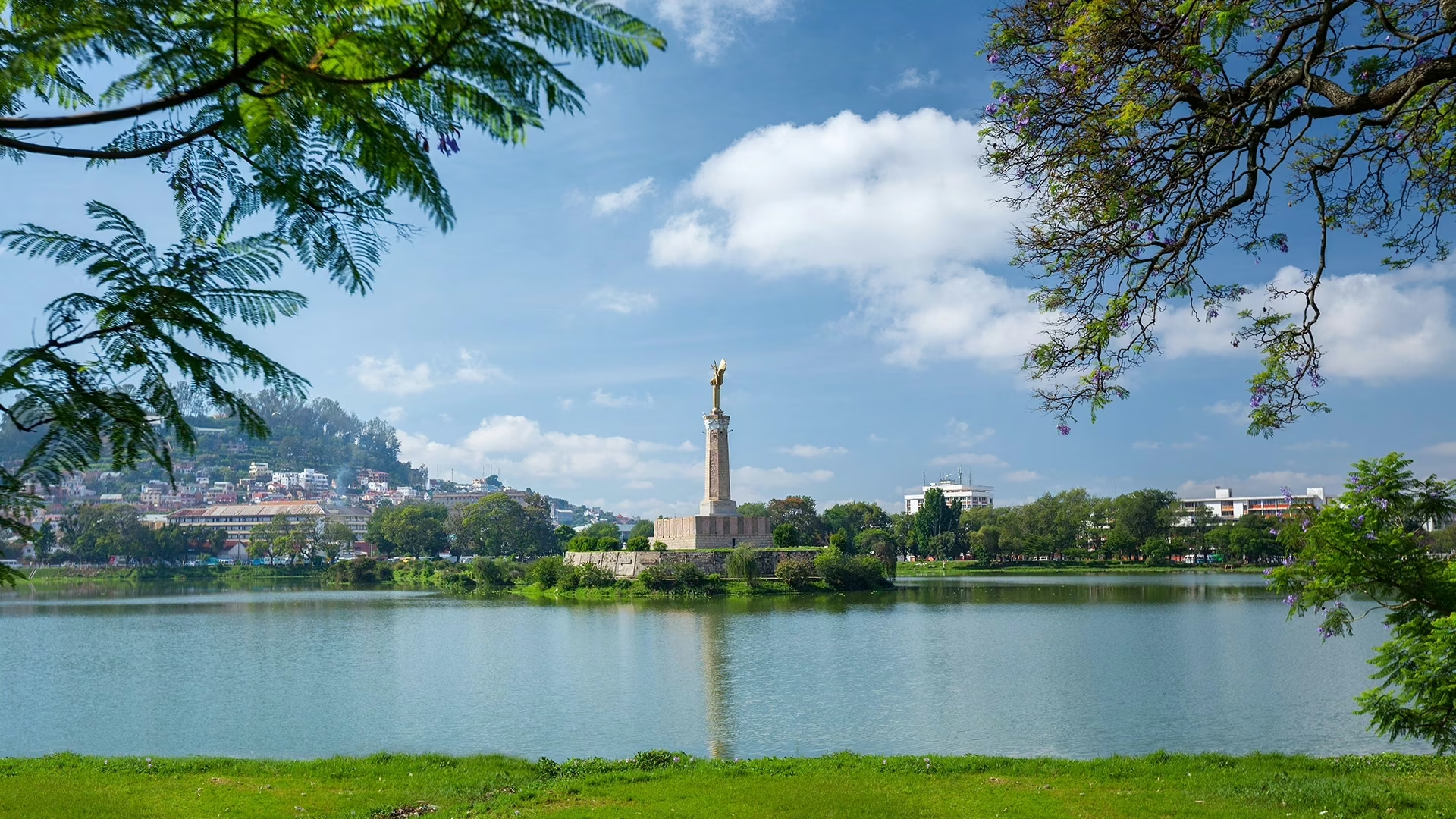
The city tumbles across steep hills, in a scramble of colour-washed walls and terracotta roofs, set amongst cobbled-street markets, rice paddies, and colonial churches. Two historic forts keep watch over the city, while the charred remains of the Rova – the Queen’s Palace – sits on its hilltop as a reminder that this was once the seat of Malagasy royalty (no, not King Julian).
Tana is a hustle and bustle of zig-zagging scooters, beeping cars and Malagasy foot traffic. This is where you say “C’est la vie”, and get amongst the chaos. And really, what are capital cities good for if not this? Eating. Shopping. Markets. Culture. History. A little bit of Mad-ness? Tana delivers it all with colour, spice, quirk and delight! You just need to know where to look in this lost city to find it.
WHEN YOU'LL GO
When to Go to Antananarivo
The Best Time to Visit Antananarivo for a City Stopover
As the gateway to all things island hopping and lemur-laden rainforest trekking, the best time to go to Tana will depend entirely on where you’re off to next. It’s the logistical handshake before the wild stuff begins!
January
Green Season
Tana in January is hot, humid and thoroughly drenched — the highlands receive over 300mm of rain this month alone, and the coast is dealing with cyclone season in full force. The city itself escapes the worst of it, but most of the island is at its most difficult to navigate.
February
Green Season
It’s the peak of cyclone season across Madagascar. Tana sits at altitude and escapes the worst of it, but much of the island bears the full force — east coast beaches are battered, rainforest lodges are largely closed, and travel is genuinely difficult. This is a month best spent planning rather than travelling.
March
Green Season
The rains slowly begin to ease in March. Tana gets pockets of beautiful weather by the end of the month — warm, sunny mornings before the afternoon showers arrive. The highlands are brilliantly green, but the coasts and the east are still difficult to reach.
April
Secret Season
The rains retreat, the sun reappears, and Tana starts to feel genuinely wonderful — warm days and cool evenings. The whole island is glowing emerald. The beaches are clearing up (although some camps and lodges are closed until mid-month), and the forests are alive with energy. April is one of Madagascar’s quietest, most beautiful months.
May
Secret Season
One of Madagascar’s finest months to begin an adventure. Tana is warm, bright and almost completely dry — clear skies, comfortable temperatures and a city that feels properly alive. Out in the rainforests, wildlife is abundant and the trails are firm. On the beaches, conditions are glorious. Rates are fair, crowds are minimal, and the whole island is quietly spectacular.
June
Secret Season
Tana’s dry season is well and truly here. Days are clear, sunny and pleasantly warm — evenings cool down significantly at altitude, so pack a layer. Out in the rainforests, wildlife is fantastically active and the light is exceptional for photography. Humpback whales begin arriving off the northeast coast by the end of the month. An excellent time to land and launch your adventure.
July
Peak Season
Travel to Madagascar picks up! Tana is cool and dry — take a jacket for evenings and early mornings at altitude, where temperatures can seriously dip. But out at the rainforests and on the beaches, conditions are superb. Humpback whales are arriving in earnest around Île Sainte-Marie and the northeast. The forests are crisp, clear and full of life.
August
Peak Season
Tana is at its driest (barely a drop of rain all month), and the evenings are genuinely chilly at altitude. Pack warm layers for after dark. Across the island, this is prime time: whale watching peaks around Île Sainte-Marie, birding is exceptional and the beaches are at their beautiful best.
September
Peak Season
Many rate September the best month in Madagascar — and it’s hard to argue with them. Tana is warm, sunny and genuinely glorious. Baby lemurs are clinging to their mothers across the rainforests, birdlife explodes in colour and noise, and whale sharks begin arriving in Nosy Be. Humpback whales are still around the northeast too. The whole island is firing on all cylinders.
October
Peak Season
Still dry and still excellent. Tana is warm and increasingly sunny as temperatures begin to build back up. Out west, it’s fossa season, whale sharks continue in Nosy Be through to December, and the rainforests are buzzing.
November
Peak Season
The first rains arrive in Tana — refreshing rather than overwhelming — and the island starts to shift gears. Wildlife remains superb across the board: whale sharks continue in Nosy Be, reptiles and frogs become dramatically active and night walks in the rainforest are absolutely extraordinary. A brilliant final window before the wet season takes hold.
December
Green Season
Early December is warm, a little wet and still wonderful — time it right and the beaches and forests are in excellent shape. But the rains build fast and the humidity rises sharply. By late December, cyclone season is looming on the horizon. Travel early in the month is best.
WHERE YOU'LL STAY
Boutique Hotels in Antananarivo
Your Madagascar Launch Pad
Our Safari Experts
Chat to an Expert
Get advice and suggestions to make this your perfect trip. We’re just a bunch of Africa-obsessed travellers ourselves, so you can rest assured that we’re trying to give you the best experience possible.
Start your journey
Nothing beats the magic of the Delta. Wild waterways, unbelievable wildlife, and that feeling that you’ve completely disappeared into nature.
Contact
For me, safari is all about the small things. The quiet sunrise drives, the stories around the fire, and the feeling that Africa gets under your skin.
ContactFrequently Asked Questions
Tana is vibrant, fascinating and very much worth your time. Our clients travel with private vehicles and expert local guides throughout, which means you can enjoy the city without any of the stress. However, like most capital cities, petty crime and pickpocketing exist, especially in busy markets, so it’s worth keeping valuables out of sight and keeping your wits about you.
Most Madagascar itineraries include one to two nights in Tana — enough to shake off the long-haul journey, take in the highlights and connect to your next destination. The Rova, the markets and the food scene alone justify an extra day. Think of it as your warm-up act for everything that follows.
More than most people expect. The Rova of Antananarivo — the royal palace complex perched on the city’s highest hill has sweeping views across the city. Ambohimanga, a UNESCO-listed royal hill about 21km outside the centre, is one of the most sacred sites in Madagascar and well worth the half-day trip. Closer in, the Analakely craft market is the place for vanilla, spices and beautifully made local handicrafts. And then there’s the food scene!
Madagascar has two official languages: Malagasy and French. English is spoken at upmarket hotels and tourist sites but is far from universal — which is exactly why having a knowledgeable local guide makes such a difference. Your guide will handle all communication, translate where needed and give you access to places and conversations that most travellers simply don’t get.
Rather brilliant, actually. Malagasy cuisine reflects the island’s cultural mix — rice is the cornerstone of almost everything, often served with zebu (the local cattle), seafood or ravitoto (pork with cassava leaves). The French colonial influence means bakeries, patisseries and proper café culture are alive and well in Tana. And of course, you’ll have the opportunity to taste Madagascar’s famous vanilla.
It depends entirely on what you’re after. Madagascar is not a typical safari destination — there are no big five, no vast open plains, no game drives at dawn. What it has instead is something altogether stranger and more extraordinary: wildlife found nowhere else on earth, landscapes that look like they belong on another planet, and a sense of genuine remoteness that’s increasingly hard to find. It rewards curiosity over comfort-seeking, and adventurous spirits over box-tickers. If that sounds like you, it might just become your favourite place on earth.
You fly into Ivato International Airport (TNR) — Madagascar’s main international gateway. Most travellers connect through Paris (Air France), Nairobi (Kenya Airways), Addis Ababa (Ethiopian Airlines) or Johannesburg (Airlink).
Yes, but it’s simple. Most nationalities receive a visa on arrival at Ivato International Airport! Make sure your passport is valid for at least six months beyond your travel dates, and you’re good to go.
Our Reviews
People are talking about us.
The most famous safari co. you've (probably) never heard of.
Hidden Africa

Chad at Hidden Africa was absolutely wonderful to work with. We worked together to fully customized our 2 week elopement … read more

Simply amazing. We have had 2 trips of a lifetime with Hidden Africa now, and plan on many more. Their … read more

I cannot recommend Hidden Africa and Chad highly enough! From the very first conversation, Chad was attentive, knowledgeable, and genuinely … read more

Geraldine worked with my friend Cheryl to arrange the most amazing Southern Africa trip. Geraldine even worked around some of … read more
HOW IT WORKS
Take a look around for a bit of inspiration.
Tell us what your dream safari looks like.
Next, your Personal Travel Planner will schedule a call to plan the perfect adventure.
Confirm your trip and get packing.
LET’S GET THIS SAFARI STARTED
Ready to go? Give us a shout and let’s start planning your next adventure. We’re almost as excited as you are.